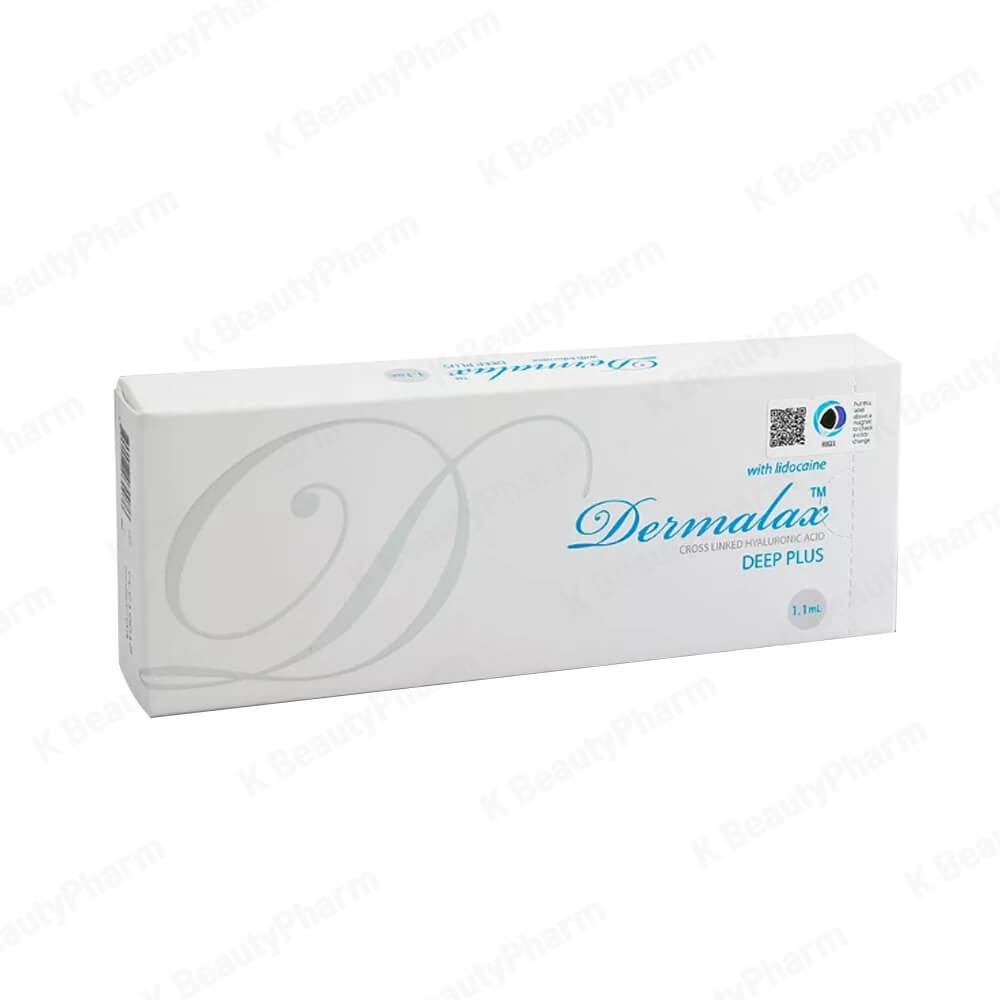
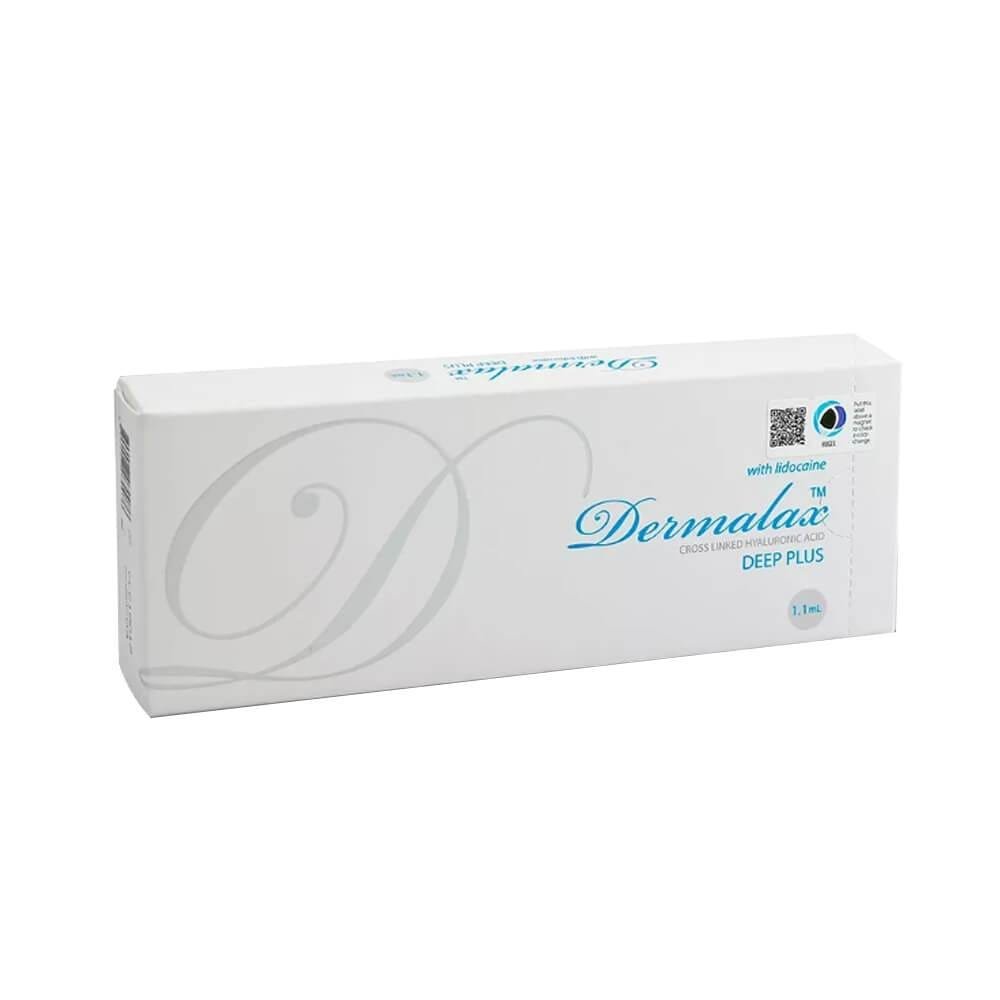
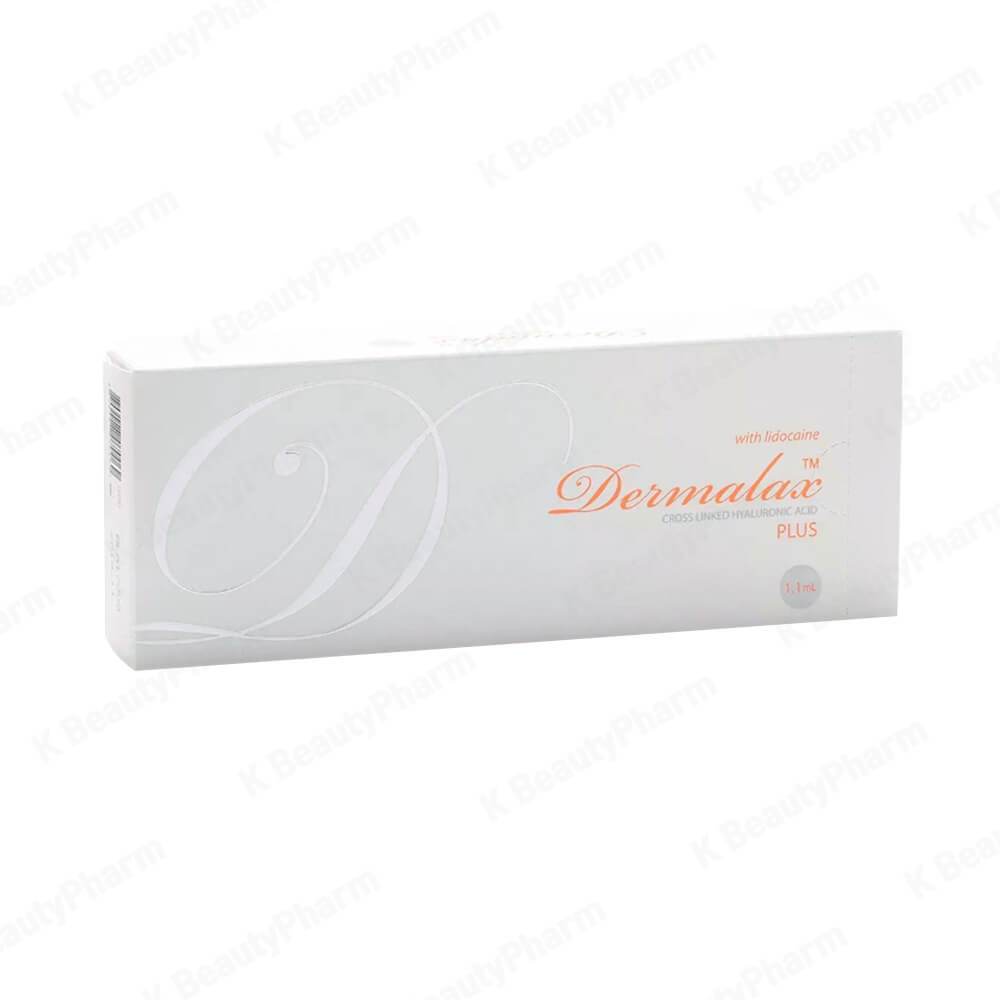
Dermalax Deep Plus with 0.3% Lidocaine | Monophasic Hyaluronic Acid Filler for Deep Facial Correction
| Specification |
Detail |
| HA Concentration |
24 mg/ml (non-animal, bio-fermented) |
| Lidocaine |
0.3% (3 mg/ml) — built-in anaesthetic |
| Gel Structure |
Monophasic, cohesive cross-linked HA |
| Cross-linking Agent |
BDDE (low-temperature process; not detectable in finished product) |
| Syringe Volume |
1.1 ml pre-filled |
| Needles |
2 × 27G included |
| Injection Depth |
Mid-to-deep dermis / superficial subcutaneous layer |
| Target Indication |
Moderate-to-deep wrinkles, volume restoration, lip augmentation |
| Duration of Effect |
6–12+ months (patient- and technique-dependent) |
| Shelf Life |
24 months from manufacture date |
| Storage |
2–25°C, original sterile packaging, away from direct light |
| Manufacturer |
Across Co., Ltd. — Hugel Pharma Group, South Korea |
| Regulatory Status |
KFDA approved · CE certified (Notified Body #1023) · |
For clinical reference only. Purchase exclusively through authorised Korean distributors like KbeautyPharm. Administer under qualified medical supervision.
What Is Dermalax Deep Plus?
Made by Across Co., Ltd. under the Hugel Pharma Group in South Korea, Dermalax Deep Plus is a sterile, monophasic, cross-linked hyaluronic acid dermal filler designed for mid-to-deep dermal injection. Dermalax Deep Plus is positioned between Dermalax Plus and Dermalax Implant Plus.
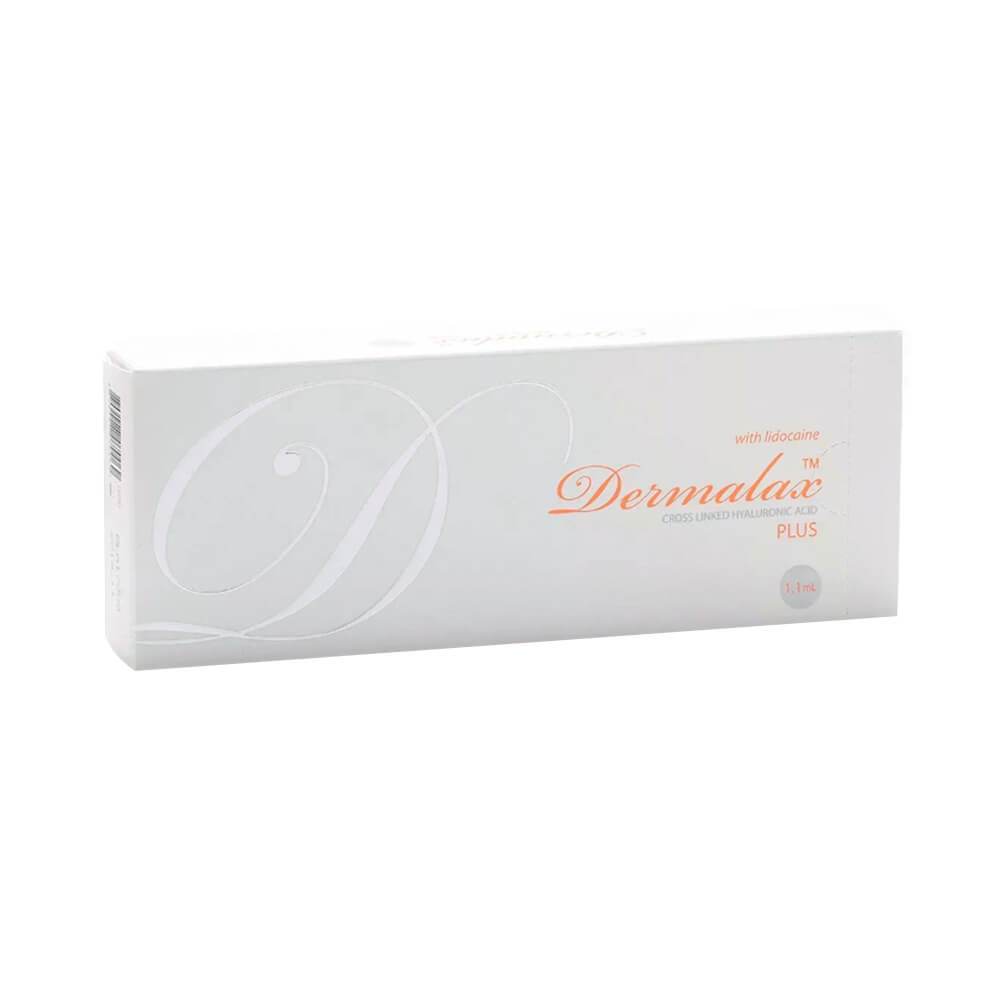
It targets mid-to-deep dermal injections, while Dermalax Plus targets fine superficial lines and Implant Plus focuses on skeletal-level volume correction in the deep subcutaneous plane. That positioning matters for treatment planning; practitioners should not use Deep Plus as a substitute for Implant Plus when significant subdermal structural support is the goal.
What sets the formulation apart from many alternatives is its low-temperature cross-linking process. Most HA fillers use butanediol diglycidyl ether (BDDE) as a cross-linking agent. Detectable residual BDDE in the final product raises biocompatibility concerns at higher concentrations.
The Across process purifies by using long-term fermentation and dialysis. This reduces BDDE to undetectable levels while maintaining a structurally stable matrix. It is not definitively established whether this offers a clinically meaningful biocompatibility advantage over properly purified biphasic fillers, but the formulation approach remains sound.
The product carries KFDA approval and CE certification (Notified Body #1023), making it commercially available across South Korea and the European Union. And holds cosmetic registration status in the United States. That distinction is worth stating clearly rather than softening.
Primary Treatment Area, Injection Technique, and Dosing
| Treatment Area |
Technique |
Volume Guidance |
| Nasolabial folds |
Linear threading or fanning |
0.2–0.3 ml per site |
| Marionette lines |
Linear threading |
0.1–0.2 ml per side |
| Lip augmentation |
Microdroplet / serial puncture |
0.3–0.5 ml total |
| Vermilion border / philtrum |
Serial puncture |
0.1–0.2 ml |
| Cheek & mid-face volume |
Bolus or fanning |
0.5–1.0 ml per side |
| Chin contouring |
Bolus |
0.3–0.5 ml |
| Jawline definition |
Linear threading |
0.5–1.0 ml per side |
| Forehead lines |
Linear threading |
0.2–0.3 ml |
| Perioral lines |
Serial puncture |
0.1–0.2 ml |
| Acne scars / depressions |
Microdroplet |
As needed per site |
For nasolabial folds and marionette lines, inject at the mid-to-deep dermis. Use linear threading or fanning at a 30-degree angle to the fold for even distribution. Lip augmentation is best done with microdroplet or serial puncture techniques. These offer better volume control than linear threading in the mobile lip area. For cheek and mid-face volumizing, use a bolus or fanning technique, injecting at the deep dermal or superficial subcutaneous level.
We recommend a touch-up after four weeks, as the product often settles and redistributes within the first two to three weeks. If you need additional correction, small supplementary volumes (0.1–0.2 ml) are usually sufficient. Therefore, minimal adjustments are often enough.
Composition and Formulation Technology
Active Ingredients
Dermalax Deep Plus contains two active components:
-
Hyaluronic acid at 24 mg/ml, cross-linked through a proprietary low-temperature BDDE process. The HA is bio-fermented from non-animal sources, with a reported purity of 99.7%. Endotoxin levels are below 0.10 EU/mL, well within the accepted clinical safety limit of 12.5 EU/mL.
-
Lidocaine hydrochloride at 0.3% (3 mg/ml), which provides local anesthesia during injection. In most cases, this eliminates the need for topical pre-treatment.
At 24 mg/ml, the HA concentration matches Juvederm Ultra Plus, and is 4 mg/ml higher than Restylane Sub-Q. Although concentration is not the only predictor of outcome, it suggests that the product targets deeper correction. Therefore, this formulation is designed for deeper correction rather than for superficial hydration. Cross-linking density, cohesivity, and rheological properties also play important roles.
Monophasic Gel Structure and What It Means in Practice
Biphasic fillers disperse HA particles within a separate carrier gel, resulting in a heterogeneous product that can behave unpredictably during injection. In contrast, Dermalax Deep Plus uses a monophasic matrix with uniform distribution of HA throughout.
This creates a more predictable product, leading to consistent needle extrusion, lower injection force, and more uniform tissue integration post-placement. It also reduces the risk of focal lumpiness. The cohesive, medium-viscosity gel is suitable for areas needing moderate lift and flexibility, such as nasolabial folds, cheeks, and lips. It provides lift without the rigidity required for subperiosteal bone-level support.
Technical data suggests resistance to hyaluronidase degradation of about 85.7%, with retained viscosity documented at six months. These figures are from the manufacturer, and real-world longevity may vary based on injection site, patient metabolism, and technique.
Each 1.1 ml pre-filled syringe allows for precise incremental delivery. The supplied 27G needle offers fine-volume control, which is especially useful for delicate areas like the perioral and tear-trough regions. In these areas, even slight overinjection can be difficult to correct quickly.
Benefits of Dermalax Deep Plus
-
Effective for Deeper Correction
Dermalax Deep Plus contains 24 mg/ml of hyaluronic acid, making it ideal for moderate-to-deep wrinkles, volume restoration, and lip augmentation.
-
Enhanced Comfort with Lidocaine
The 0.3% lidocaine provides built-in anesthesia during injection, reducing discomfort and eliminating the need for pre-treatment.
-
Consistent Results with Monophasic Structure
The monophasic gel ensures uniform HA distribution, allowing for consistent needle extrusion and minimizing the risk of lumpiness.
-
Long-lasting Effects
The results last between 6 and 12+ months, depending on the patient’s factors, providing a durable solution for facial correction.
-
Low-temperature Cross-linking for Safety
The proprietary low-temperature BDDE process reduces residual BDDE to undetectable levels, enhancing biocompatibility and stability.
-
Versatile Treatment Areas
Dermalax Deep Plus is suitable for various areas, including nasolabial folds, marionette lines, lips, cheeks, chin, and jawline.
-
Regulatory Approval
The product is KFDA-approved and CE-certified, ensuring it meets high safety and regulatory standards.
-
Precise Delivery
The 1.1 ml pre-filled syringe and 27G needles allow for precise control, making injections easier, especially in sensitive areas.
-
Minimal Downtime
Common side effects, such as swelling and bruising, typically resolve within 48–72 hours, allowing for quick recovery.
-
Reversible for Safety
Dermalax Deep Plus is fully reversible with hyaluronidase, providing an added layer of safety for both practitioners and patients.
-
Improved Injection Comfort
Clinical studies show reduced pain during injection compared to other fillers, enhancing patient comfort.
-
Authenticity Assurance
By purchasing from authorized distributors (KbeautyPharm), practitioners can avoid counterfeit products and ensure safety.
-
Well-Established in Key Markets
Dermalax Deep Plus complies with regulatory standards in South Korea and the European Union, providing a trusted option for practitioners.
Frequently Asked Questions
Is Dermalax Deep Plus FDA approved?
No. It holds KFDA approval and CE certification but has not received FDA clearance. In the United States, the product is registered as a cosmetic.
How long do results from Dermalax Deep Plus last?
Clinical data from the 324-subject RCT show maintained improvement at 36–48 weeks in the majority of patients. Most practitioners cite 6–12 months as a practical range, with some individual variation based on injection site, patient metabolism, volume administered, and lifestyle factors such as sun exposure and physical activity.
Is Dermalax a good filler compared to Restylane?
Yes, The available RCT data are favourable. In the 324-subject multicenter trial, Dermalax Deep achieved a 93.75% response rate at 24 weeks versus 89.44% for Restylane, and maintained improvements more consistently at 36 and 48 weeks. A separate 2017 study showed substantially lower injection pain with Dermalax (14.65 mm vs. 38.29 mm on VAS). Both Restylane and Dermalax are clinically well-supported.
Is Dermalax Deep Plus better than Juvederm Ultra Plus?
No published head-to-head clinical trial compares these two products directly. Both carry 24 mg/ml HA and 0.3% lidocaine in a monophasic gel structure, making them compositionally similar. Juvederm’s VYCROSS cross-linking technology differs from Dermalax’s low-temperature BDDE process. Juvederm holds FDA approval; Dermalax does not. Comparative claims beyond formulation specs require caution without direct trial data.
What are the main ingredients in Dermalax Deep Plus?
The active ingredients are hyaluronic acid (24 mg/ml, non-animal bio-fermented source) and lidocaine hydrochloride (0.3%). BDDE is used as a cross-linking agent during manufacturing but is not detectable in the finished product. The formulation contains no animal-derived components, stabilisers, or toxic additives.
Can Dermalax Deep Plus be dissolved if needed?
Yes. Hyaluronidase dissolves the cross-linked HA matrix efficiently. The product also metabolises naturally through normal enzymatic pathways over its effective duration. Practitioners should keep hyaluronidase readily available during all filler procedures as standard practice.
What are the risks of buying Dermalax from unofficial sources?
A 2025 safety review documented contaminated and incorrectly formulated counterfeit Dermalax products causing severe adverse events. Practitioners should purchase only through authorised distributors, verify batch numbers through official Across Co. channels, and inspect CE and KFDA documentation in every shipment. Unofficial marketplace or social-channel sourcing carries both clinical and legal risk.
Disclaimer: For licensed medical professionals only. KBeautyPharm is not liable for any harm from self-injection.This revised product description incorporates data from two research documents (March 2026) and peer-reviewed clinical trial sources including a multicenter RCT published on ResearchGate and a PubMed-indexed trial (PMID: 28145073). Information is provided for clinical and educational reference. Not a substitute for professional medical judgment, local regulatory guidance, or manufacturer prescribing information.