Natural Fillers for the Face: 5 Types, 6 Treatment Areas, and Honest Results

Natural fillers are one of the fastest-growing categories in aesthetics. People want results that look like themselves — not like someone else. This guide explains what natural fillers are, which types work best for specific face areas, and what clinical evidence shows about outcomes and safety.
What Are Natural Fillers?
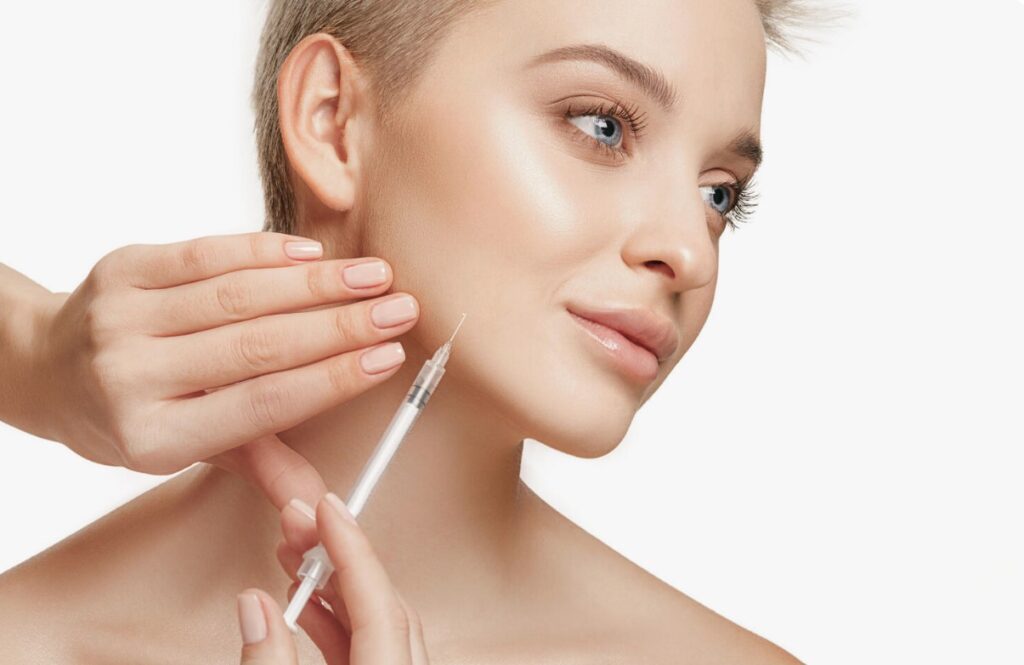
Natural fillers are injectable or topical substances that restore facial volume, smooth wrinkles, or enhance features using biocompatible materials. The term has 2 distinct meanings in aesthetics.
The first meaning refers to the material. Natural fillers use substances found in — or similar to — what the body already produces. These include hyaluronic acid, calcium, and blood plasma. The second meaning describes the aesthetic outcome: results that look believably refreshed, not overdone.
Most patients want both. A 2023 IMCAS symposium review found that 73% of patients requesting dermal fillers want natural, healthy-looking results. Patient surveys after treatment showed people felt “more confident, beautiful, and empowered while still looking like themselves.”
The 2 Meanings of “Natural” in Aesthetic Fillers
The confusion around this term comes from 2 overlapping ideas. Natural origin means the filler uses a biocompatible material. Natural appearance means the result integrates with your face without looking artificial.
Hyaluronic acid (HA) satisfies both definitions. Your skin produces it. Injectable HA mimics that same molecule at higher concentrations. When placed correctly, it creates volume indistinguishable from your own tissue.
5 Types of Natural Fillers Explained
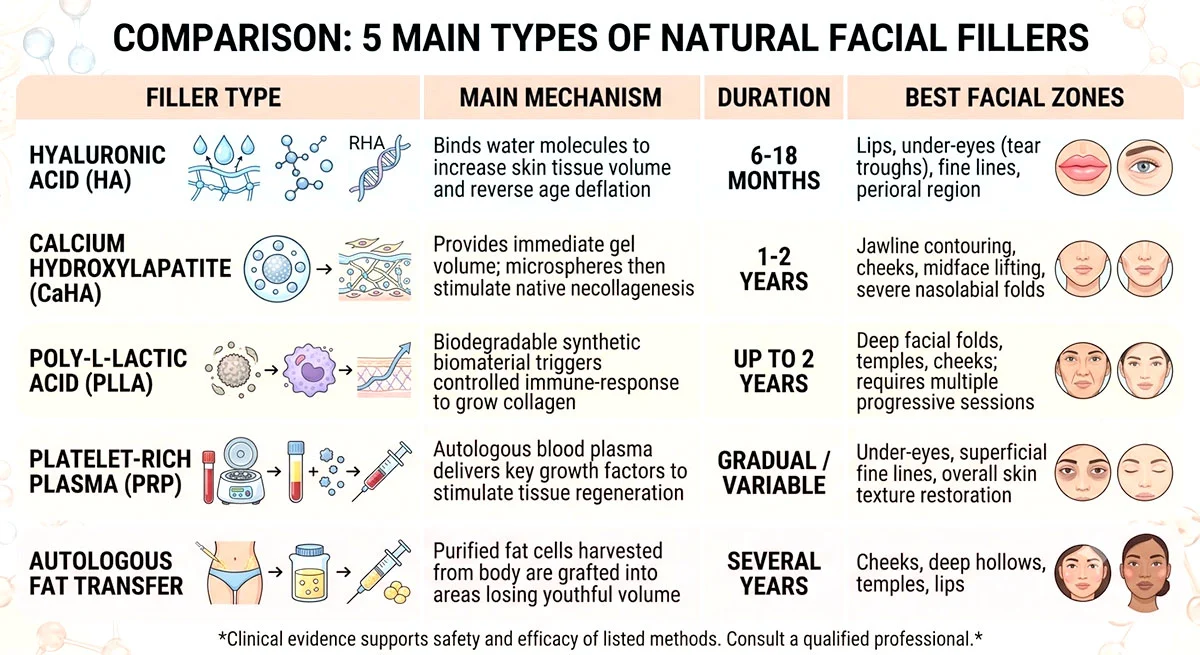
There are 5 main types of natural fillers used clinically. They are hyaluronic acid, calcium hydroxylapatite, poly-L-lactic acid, platelet-rich plasma, and autologous fat.
1. Hyaluronic Acid (HA) Fillers — Most Widely Used
HA fillers are the most natural filler type available. HA is a naturally occurring acidic mucopolysaccharide in human skin. It binds up to 1,000 times its own weight in water. This hydrophilicity increases tissue volume and counteracts age-related deflation. As HA levels in the skin decrease with age, lines deepen and facial structure softens.
Injectable HA replicates this molecule at therapeutic concentrations. Crosslinking extends the filler’s duration to 6–18 months, depending on formulation.
| Filler Rheology Property | Structural Behavior | Ideal Facial Treatment Zone |
| High G’ (Elastic Modulus) | Resists deformation under pressure; high lifting capacity. | Deep cheeks, jawline, midface structural support. |
| Low G’ (Elastic Modulus) | Highly flexible, soft, and dynamic movement. | Lips, fine superficial lines, smile lines. |
| High Cohesivity | Stays localized; distributes evenly in deep tissue planes. | Deep structural preperiosteal layers. |
| Low Hygroscopy | Low water binding; minimal post-injection swelling. | Tear troughs and delicate under-eye compartments. |
6 properties determine which HA product suits which area:
- G’ value (elastic modulus): High G’ resists deformation under pressure. It suits deep wrinkles and structural cheek support. Low G’ suits lips and superficial lines.
- Cohesivity: High-cohesion products distribute evenly in deep tissue. Low-cohesion products spread well in mobile zones.
- Particle size: Larger particles address deeper volume deficits. Smaller particles treat superficial lines.
- Swelling factor: High-expansion formulas suit deep nasolabial folds. They can cause problems in delicate areas like the tear trough.
- Degree of crosslinking: Higher crosslinking extends duration. It also increases resistance to enzymatic breakdown.
- Concentration: Standard concentrations for clinical fillers are 20–24 mg/mL.
Korean HA fillers including Revolax Deep, Revolax Fine, Neuramis Deep, and Neuramis Volume are formulated across this spectrum. Each product targets a specific facial zone based on these rheological properties.
RHA (Resilient Hyaluronic Acid) represents the newest HA generation. RHA fillers preserve the natural HA structure through a modified manufacturing process. They adapt to facial movement — during talking, laughing, and smiling.
This makes them the top choice for high-movement areas like the lips, marionette lines, and perioral region. The RHA range covers 4 indications: RHA 1 for superficial dynamic wrinkles, RHA 2 for vermillion border and lip reshaping, RHA 3 for dynamic volumization and marionette lines, RHA 4 for cheekbone and structural support.
2. Calcium Hydroxylapatite (CaHA) — Volassom
CaHA fillers work in 2 stages: immediate volume through a gel carrier, then sustained collagen stimulation through microspheres. Calcium and phosphate ions form naturally in bone and teeth. CaHA uses this same composition in smooth, round microspheres.
The gel carrier absorbs within 3–6 months. The remaining CaHA microspheres act as a scaffold. Fibroblasts deposit new collagen around them. This neocollagenesis produces lasting structural improvement. Results from CaHA typically last 1–2 years.
A 2025 systematic review of 2,779 patients showed that only 3% experienced adverse effects from CaHA filler. Most of these were nodules that resolved without intervention.
CaHA suits these 4 applications:
- Moderate-to-severe nasolabial folds
- Jawline definition and contouring
- Cheek volumization and midface lifting
- Skin augmentation when hyperdiluted (for diffuse collagen stimulation)
CaHA is not suitable for the lips, fine lines, or the under-eye area. Its high viscosity risks nodule formation in highly mobile or delicate zones.
3. Poly-L-Lactic Acid (PLLA) — Sculptra, Ruella, Olidia
PLLA fillers do not provide immediate volume. They stimulate the body to produce its own collagen over 3–6 months. PLLA is an FDA-approved biodegradable synthetic biomaterial. When injected, it triggers a controlled inflammatory response. This recruits macrophages, which stimulate fibroblasts, which produce neocollagen.
Results develop gradually. Duration reaches up to 2 years. A study of 80 patients found that over 86% achieved significant improvement in nasolabial folds after PLLA injections. Most adverse events were minor and transient.
PLLA requires a minimum of 3 sessions spaced weeks apart. It is not appropriate for the periorbital region or around the mouth. High-dose injections in these areas cause nodule formation visible to the naked eye.
4. Platelet-Rich Plasma (PRP)
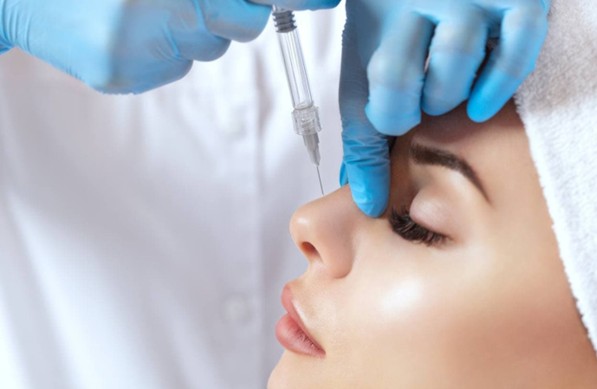
PRP fillers use your own blood plasma to restore volume and stimulate tissue regeneration through concentrated growth factors. The process involves drawing blood, centrifuging it to separate platelets, and injecting the plasma into targeted areas.
PRP contains 3 key growth factors: platelet-derived growth factor, vascular endothelial growth factor, and fibroblast growth factor. These regulate cell proliferation, promote vascular growth, and stimulate collagen synthesis.
PRP is biocompatible. The risk of allergic reaction is near zero. Results are gradual and subtle. Duration varies by individual response. PRP suits patients who prefer autologous treatments and avoid synthetic materials entirely.
5. Autologous Fat Transfer
Autologous fat transfer uses your own fat cells to restore facial volume lost to aging. Fat is harvested from the lower abdomen or medial thigh — areas with the highest cell viability. After harvesting, it is purified and injected into the cheeks, temples, lips, or under-eye hollows.
Fat grafting is the most biologically natural filler option. All material comes from your own body. Results can last several years when graft viability is maintained. Fat absorption rates vary between patients, making repeat sessions sometimes necessary.
A comparison study of 147 patients over 24 months found autologous fat to be highly effective, with significantly lower cost than synthetic fillers and high patient satisfaction scores.
Natural Fillers for Lips
Lip treatment is the most requested filler procedure. Nearly 2.6 million soft tissue injections targeted the lips in 2018. This represented a 312% increase between 2000 and 2017.
The best natural fillers for lips are low-to-moderate G’ HA products that allow dynamic movement without stiffness. The goal is to create a shape that harmonizes with the patient’s unique facial features, age, and ethnic background.
HA Formulas That Work Best for Lip Enhancement
Lower-viscosity HA products with high spreadability suit lip augmentation. They integrate within the lip mucosa and adapt to movement. Revolax Fine and Neuramis Light are formulated for this purpose. Their fine-particle HA creates seamless, natural-feeling results in the vermillion border and lip body.
Prominent signs of lip aging include:
- Lengthening of the cutaneous upper lip
- Development of perioral rhytids (barcode lines)
- Collapse of oral commissures
- Inversion of the red vermillion border
- Flattening of the cupid’s bow and philtrum columns
Each of these needs a different injection technique and product viscosity.
RHA Fillers for Natural Lip Movement
RHA 2 and RHA 3 are engineered for the perioral region. High stretch with moderate-to-high strength allows dynamic lip reshaping. These products maintain natural lip mobility during facial expressions. They do not create the stiffness seen with older, more rigid HA formulas.
4 rules for natural lip filler results:
- Maintain balance between upper and lower lips. Overvoluming one lip creates disproportion.
- Avoid over-volumization. Conservative amounts produce more believable results.
- Respect injection depth. Lip injections should remain less than 3 mm deep.
- Honor individual anatomy. Each patient’s cupid’s bow, vermillion border, and philtrum define their unique lip architecture.
Natural Fillers for Under Eyes
Low-hygroscopy, high-spreadability HA fillers are the best natural fillers for under-eye treatment. The tear trough has very thin tissue — approximately 3 tissue layers compared to 10 at the temple. Product selection and injection depth are critical here.
Why the Under-Eye Area Requires Specialist Products
The under-eye region contains a delicate lymphatic system. The malar septum divides the superficial suborbicularis oculi fat into a superficial compartment (with compromised lymphatic drainage) and a deep compartment (connected to cheek drainage).
Injecting fillers superficial to the malar septum blocks lymphatic drainage. This causes malar edema. A retrospective study of 51 patients who received HA in the infraorbital hollows found that 12 patients (23.5%) developed prolonged periorbital edema averaging 5.4 months in duration.
Products for the tear trough must have:
- Low hygroscopy (to avoid retaining water and swelling)
- High spreadability (to distribute without visible lumping)
- Low elasticity and viscosity (to avoid compressing lymphatics)
Korean PDRN-based products like Rejuran I and SheerEyes target under-eye concerns differently from HA fillers. Rather than adding volume, PDRN promotes tissue regeneration, improves skin tone, and reduces the appearance of dark circles through cellular repair — without adding volumizing load to a lymphatically sensitive zone.
What to Expect After Under-Eye Filler
Results include reduced infraorbital hollowing and decreased shadow depth. HA under-eye filler lasts 9–12 months. Malar edema risk is lowest when low-viscosity HA is placed at the preperiosteal level, deep to the malar septum.
Natural Fillers for Cheeks and Midface
Mid-to-high G’ HA products or CaHA injected at the preperiosteal level are the best natural fillers for cheek volumization. The midface requires structural support. This is different from the softer products used in the lips or tear trough.
Facial aging affects the midface through 3 concurrent mechanisms:
- Facial bone recession — the skeleton recedes and remodels, reducing structural support
- Fat pad descent — superficial fat pads migrate inferiorly and medially over the bony foundation
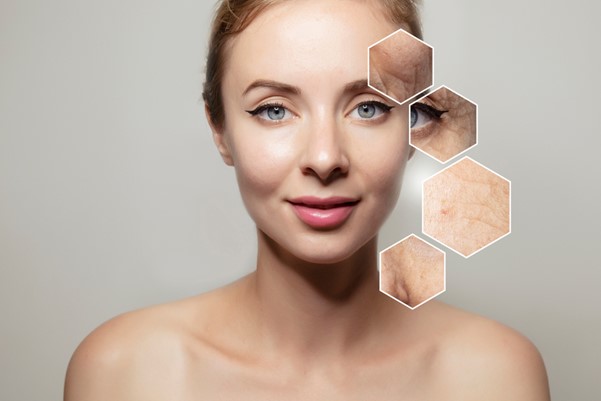
- Skin laxity — reduced collagen and elastin allow overlying tissue to descend
Deep fat compartments remain relatively stable during aging. Deep injections at the preperiosteal level provide structural support and project the midface forward. This principle guides cheek filler placement.
Revolax Deep and Neuramis Deep suit supraperiosteal cheekbone injection. Their high G’ formulation resists compression, maintains structural projection, and distributes naturally at depth. CaHA suits patients who want immediate definition with long-term collagen stimulation in the jawline and cheek regions.
Natural Fillers for Smile Lines and Nasolabial Folds
High-strength, high-stretch HA fillers are the best natural fillers for smile lines and nasolabial folds. This combination provides dynamic volumization that holds up during facial movement. A filler that cannot adapt to movement creates visible lumps during animation.
Nasolabial folds develop through 3 anatomical changes:
- Medial cheek fat pad descent
- Jowl fat compartment enlargement
- Nasolabial fat pad hypertrophy
Filler placement for nasolabial folds runs medial to the mandibular ligament, threading upward toward the oral commissure. This technique avoids weighing down the superficial fat compartment — which would deepen the fold rather than soften it.
For marionette lines, the same high-stretch principle applies. Filler is deposited in long retrograde threads medial to the mandibular ligament. Injecting too laterally pulls the facial fat compartment downward, worsening the appearance over time.
CaHA is not appropriate for fine lines around the mouth. Its high viscosity causes nodules in highly mobile zones.
What Makes Filler Look Natural?
Natural-looking results depend on 3 factors: product selection, precise injection technique, and knowledge of facial anatomy. No product guarantees natural results on its own.
A panel of experts at IMCAS 2023 defined 5 key strategies for natural outcomes:
- Thorough patient assessment with individualized treatment planning
- Precise knowledge of facial anatomy, including fat compartments and vascular danger zones
- Proper injection technique — controlling depth, volume, injection speed, and instrument type
- Understanding of each filler’s rheological properties
- A consistently conservative treatment approach
The Injector’s Artistic and Clinical Role
Expert injectors assess the face in both rest and animation. They identify the exact fat compartments, vascular pathways, and tissue planes relevant to each injection. They adapt volume in real time rather than adhering rigidly to pre-planned amounts.
Over-volumization is the most common cause of unnatural filler results. It distorts facial harmony. One of the defining features of skilled injectors is knowing when to stop, not just where to inject.
The 5 Anatomical Layers of the Face
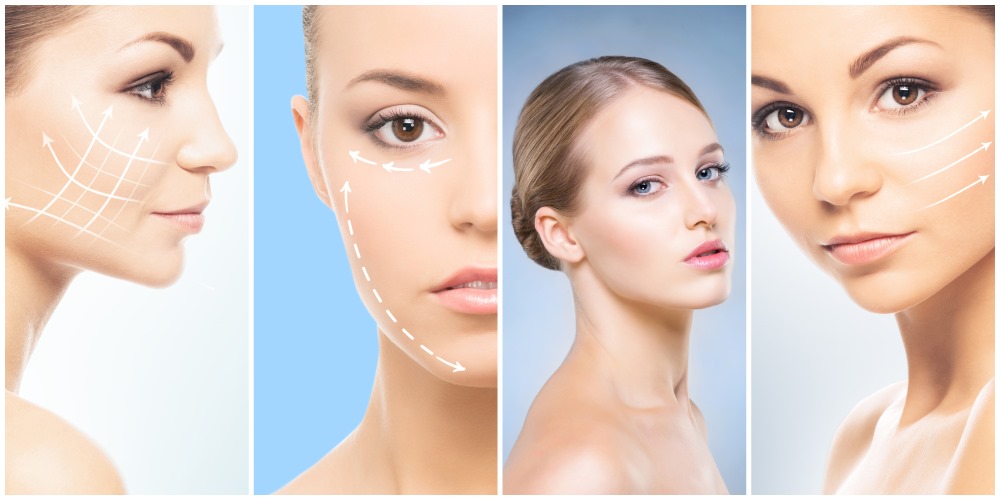
The face has 5 anatomical layers from surface to deep: skin, subcutaneous fat, superficial musculoaponeurotic system (SMAS), deep fat, and bone. The SMAS connects blood vessels and motor nerves. The depth of injection determines the outcome in each region.
Knowing which layer to target prevents 3 types of complications:
- Lumpiness from incorrect compartment placement
- Animation deformities from filler placed against a muscle plane
- Vascular compromise from injection near facial arteries
The facial artery system — with branches including the angular artery, superior labial artery, inferior labial artery, and supratrochlear artery — creates high-risk zones in the nose, glabella, and nasolabial fold areas.
Natural Alternatives to Fillers
There are 4 clinically supported alternatives to injectable fillers. They are microneedling with PRP, radiofrequency microneedling, laser resurfacing, and medical-grade skincare.
None of these alternatives replicates the volumizing effect of injectable fillers. However, they stimulate collagen naturally and improve skin quality over time.
- Microneedling with PRP — controlled micro-injuries trigger the body’s healing response, stimulating collagen and elastin. PRP adds concentrated growth factors. Results are gradual and develop over 4–8 weeks.
- Radiofrequency microneedling (Morpheus8) — fractional RF energy remodels deep collagen and tightens lax tissue. It addresses mild sagging and softens fine lines without adding volume.
- Halo laser resurfacing — ablative and non-ablative wavelengths improve tone, texture, and collagen density. The body rebuilds its own structural collagen over time.
- Medical-grade skincare — retinoids, peptides, and AHA/BHA support long-term collagen synthesis. This approach prevents further volume loss but cannot restore what has already been lost.
What At-Home Options Cannot Do
Topical HA serums hydrate the skin surface. They do not replace lost facial volume. Collagen creams cannot penetrate deep enough to rebuild dermal structure. Facial exercises do not regenerate collagen. Essential oils have no clinical evidence for facial volumization.
Are Natural Fillers Safe?
Natural fillers — particularly HA-based products — have a well-established safety profile. Most adverse events are mild, transient, and resolve without treatment.
The 5 most common side effects of dermal filler treatment are:
- Bruising (all fillers carry this risk; blunt cannulas reduce it compared to sharp needles)
- Transient edema (resolves within 1 week in most cases)
- Redness at the injection site (typical; resolves within hours)
- Tenderness around the injection site
- Itching (rare; indicates possible hypersensitivity)
Rare but Serious Complications
Serious adverse events are rare. They fall into 3 main categories:
- Vascular compromise — intravascular injection causes tissue necrosis, vision loss, or stroke. The glabella, nose, and nasolabial fold are the highest-risk zones. A systematic review of 165 vascular embolism cases found central retinal artery occlusion in 31% of cases, ophthalmic artery occlusion in 20%, posterior ciliary artery occlusion in 14%, and acute cerebral infarction in 14%.
- Foreign body granulomas — estimated incidence is 0.01%–1%. These appear months to years after injection. HA granulomas respond to hyaluronidase. Non-HA granulomas require intralesional corticosteroids or 5-fluorouracil.
- Biofilm infections — bacterial biofilms cause chronic inflammatory nodules. Antibiotic treatment with ciprofloxacin 500 mg twice daily plus clarithromycin for 4–6 weeks is first-line.
CRITICAL PATIENT SAFETY WARNING: While soft tissue fillers are overwhelmingly safe when administered correctly, accidental intravascular injection poses severe medical risks. High-risk anatomical areas include the glabella, nose, and nasolabial folds. Immediate clinical intervention using hyaluronidase is required if vascular occlusion occurs.
Why HA Is the Safest Natural Filler
HA fillers carry 1 safety advantage no other filler type can match: reversibility with hyaluronidase. If overfilling occurs, hyaluronidase dissolves the product immediately. If vascular occlusion happens, hyaluronidase is injected near the ischemic area as part of the emergency protocol.
CaHA, PLLA, and PMMA have no reversal agent. If a serious adverse event occurs with these products, management is significantly more limited.
FAQ
What is the most natural-looking filler?
HA fillers are the most natural-looking option because they integrate seamlessly with tissue and are fully reversible. RHA (Resilient Hyaluronic Acid) fillers specifically engineered for facial movement are the top choice for mobile areas like the lips and perioral region.
How can I plump my face without fillers?
Microneedling with PRP and radiofrequency microneedling are the most effective non-filler options for facial plumping. Both stimulate the body’s own collagen production. Neither replicates the immediate volumizing effect of injectable fillers, but results improve progressively over 3–6 months.
What is a natural alternative to fillers?
The 4 main natural alternatives to fillers are microneedling with PRP, radiofrequency microneedling, laser resurfacing, and autologous fat transfer. Topical serums provide surface hydration only and cannot restore lost facial volume.
How do I restore volume in my face naturally?
Autologous fat transfer is the most natural method for restoring lost facial volume. It uses your own fat cells from the abdomen or thighs. For a non-surgical approach, PLLA (Sculptra) stimulates your own collagen production over 6–12 months with results lasting up to 2 years.
What fillers work best for perioral lines and smile lines?
High-strength, high-stretch HA fillers work best for perioral lines and nasolabial folds. They adapt to the constant movement around the mouth without losing their form. Placement medial to the mandibular ligament, threading upward in retrograde, produces the most natural aesthetic result.
Are natural fillers permanent?
No natural filler type is permanent. HA fillers last 6–18 months depending on crosslinking density. CaHA lasts 1–2 years. PLLA lasts up to 2 years. Autologous fat produces the longest duration — several years when graft viability is maintained.
Final Thoughts: Science with Artistry
Achieving a truly natural filler result is never a matter of luck; it is a clinical discipline. As the data shows, the most successful outcomes happen when an expert injector matches the precise rheological property of a filler—such as high stretch for smile lines or low hygroscopy for under-eyes—with the unique nuances of your facial anatomy.
By prioritizing biocompatibility, opting for conservative treatment volumes, and respecting the underlying vascular architecture, modern aesthetics allows you to effortlessly look like a refreshed, vibrant version of yourself.
References
- Under-Eye Retrospective Analysis & Periorbital Edema Study
Title: Dermal fillers in aesthetics: an overview of adverse events and treatment approaches
URL: https://pmc.ncbi.nlm.nih.gov/articles/PMC3865975/
- Calcium Hydroxylapatite (CaHA) Safety and Nodule Incidence Review
Title: Calcium hydroxylapatite: A review on safety and complications
- Biostimulatory Profiles & Clinical Applications of PLLA and CaHA
Title: Facial Injectable Fillers in Aesthetic Medicine: Clinical Applications and Safety Strategies
URL: https://pmc.ncbi.nlm.nih.gov/articles/PMC12684002/
- Regenerative Aesthetics & Calcium Hydroxylapatite (Radiesse) Framework
Title: The Role of Calcium Hydroxylapatite (Radiesse) as a Regenerative Aesthetic Treatment: A Narrative Review
URL: https://pmc.ncbi.nlm.nih.gov/articles/PMC11025388/